
Agentic AI for the cath-lab decision.
APEX is a multi-agent clinical decision support system that fuses angiography, guidelines, and patient-specific digital twins — so heart teams can commit to the right revascularization strategy with the evidence in one place.
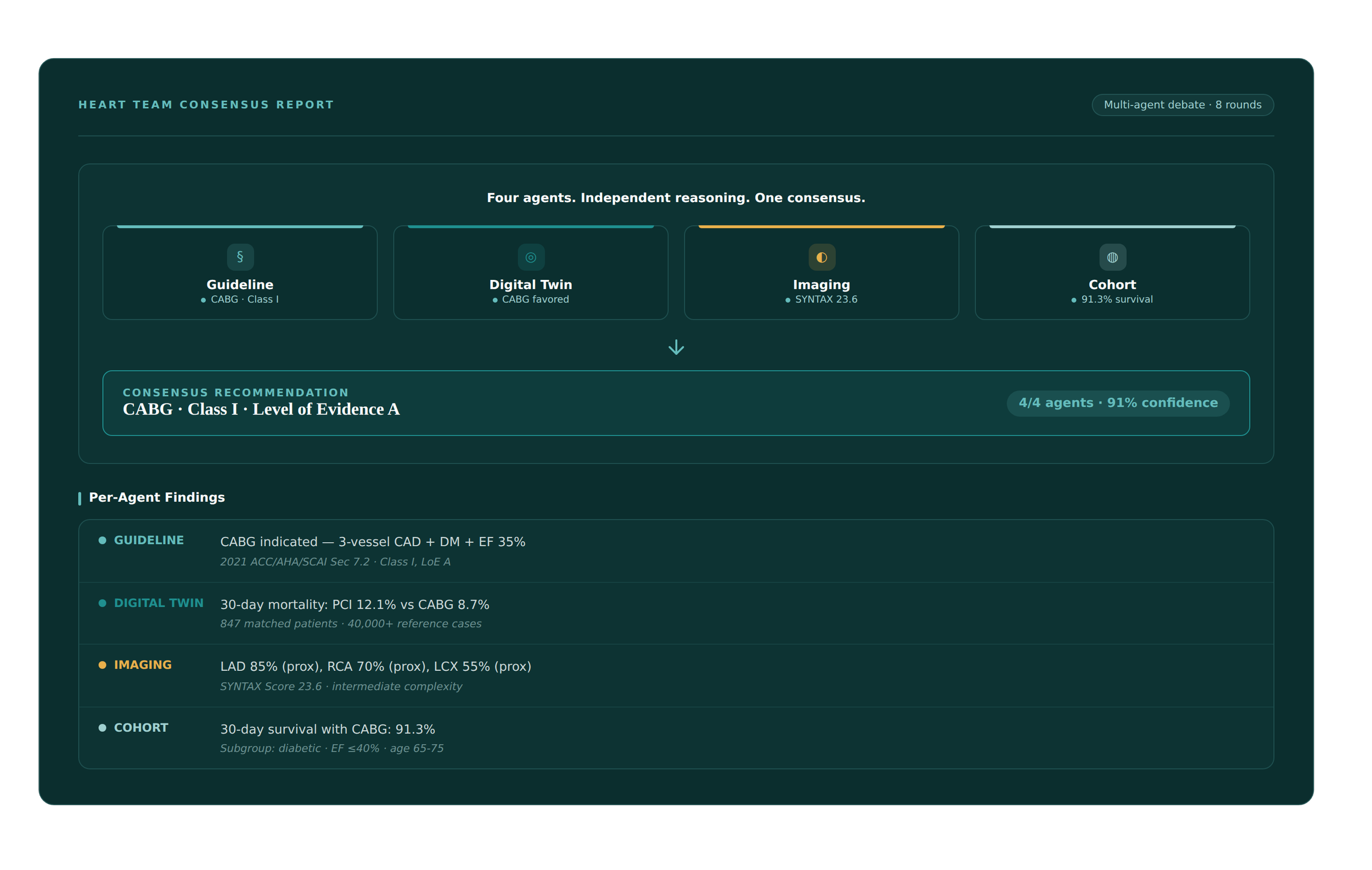
Sequential pipeline. Clear contracts.
Each agent has a specific clinical responsibility. The heart team can see exactly what informed each recommendation.
Ingest & normalize
Patient record, angiogram, and procedure context — normalized with provenance on every field.
Guideline
ACC/AHA & ESC eligibility class with the citation and specific criteria met.
Digital Twin
Matched cohort projection — observed survival at 30 days and 1 year for PCI vs. CABG.
Imaging
Per-vessel stenosis with image-level markup traceable to the source frame.
Cohort
Five nearest-neighbor patients and their observed outcomes, case-by-case.
Heart-Team Report
One synthesized consensus with per-agent reasoning — export PDF or FHIR.
Five specialized agents. One decision-ready report.
APEX orchestrates five AI agents working on the same patient. The output is a single, auditable brief the heart team can act on.
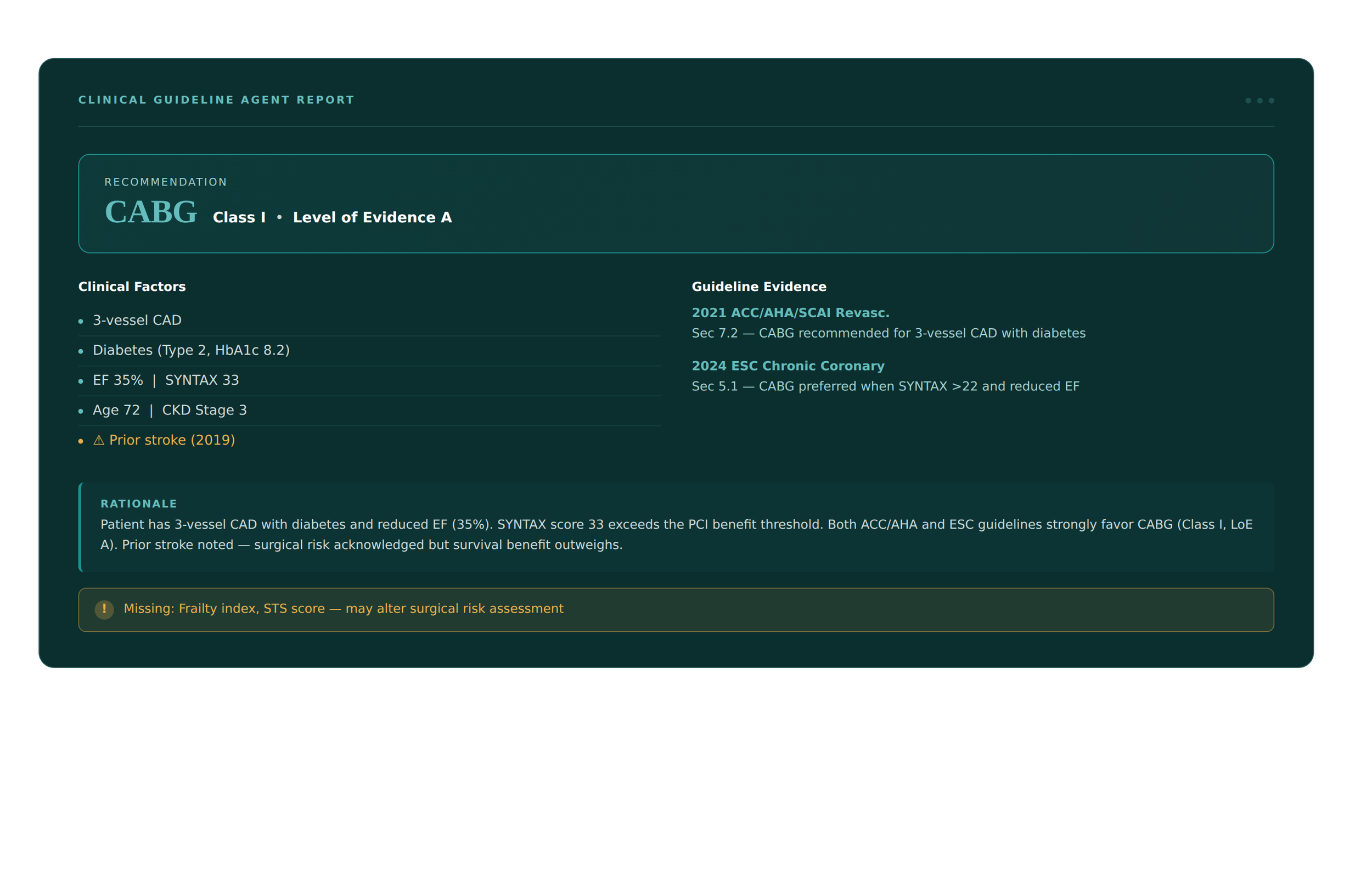
ACC/AHA and ESC eligibility — with the citation attached.
The Guideline Agent maps the patient to the relevant sections of the current revascularization guidelines. It returns the eligibility class, the citation, and the specific criteria that applied.
- Pinned to ACC/AHA 2021 and ESC 2024 revascularization guidelines
- Class I / IIa / IIb / III with Level of Evidence and citation
- Flags missing data that would alter the recommendation
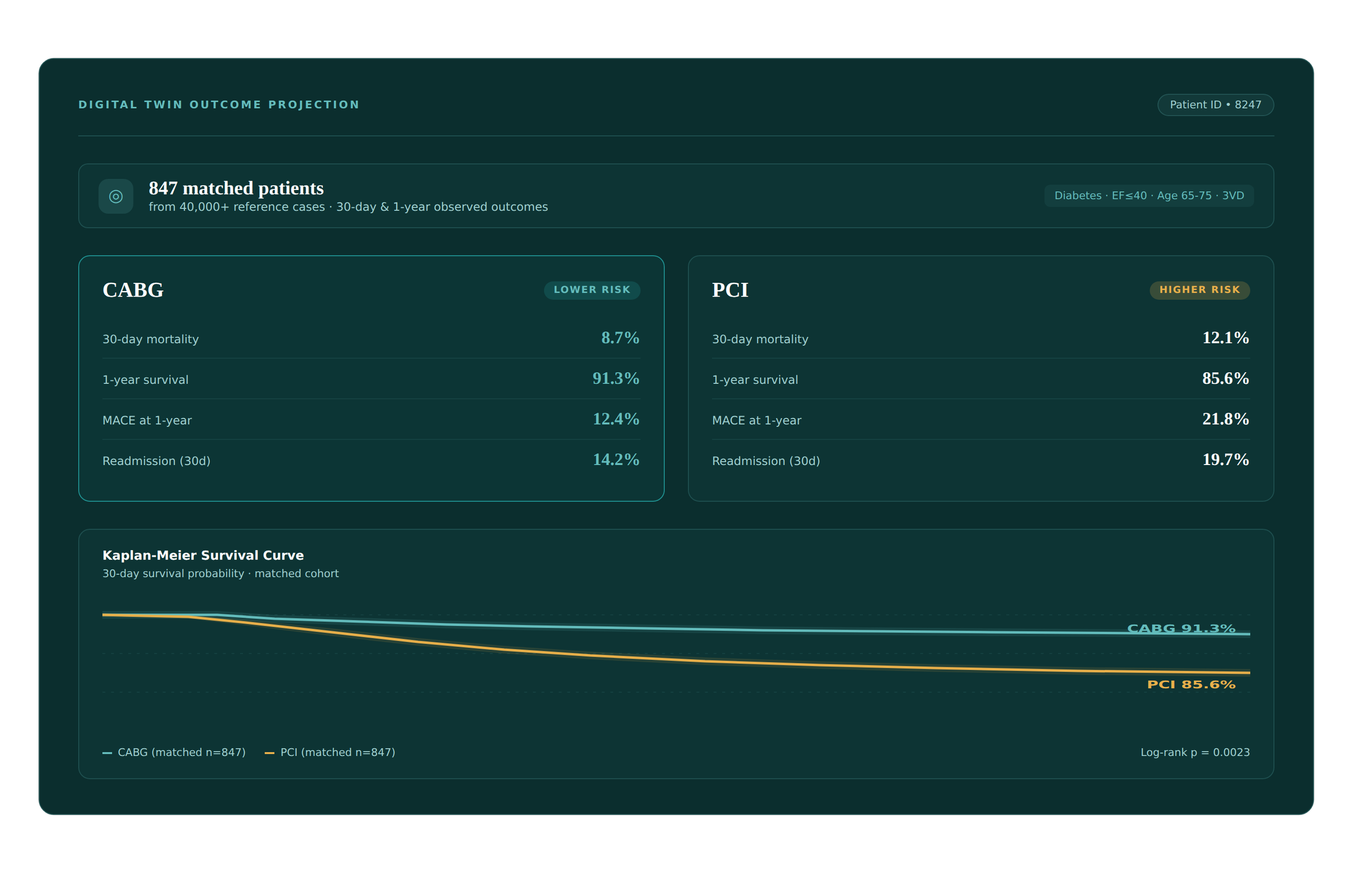
Patient-matched outcome projection — not an opaque score.
The Digital Twin Agent retrieves the closest-matching patients from the reference cohort and presents their observed survival under each treatment path.
- 30-day and 1-year mortality, MACE, and readmission
- Nearest-neighbor matching on a high-dimensional patient embedding
- Kaplan-Meier curve for the matched subgroup with log-rank p-value
Stenosis detection the heart team can audit.
The Imaging Agent localizes and measures stenoses on angiogram frames. Every finding is linked to the source image and frame number.
- Per-vessel percent stenosis with confidence scores
- Automated SYNTAX score with complexity tier
- Frame-level annotation traceable to the original study

Ask the reference population a question in plain English.
The Cohort Agent converts natural-language questions into SQL against 40,000+ reference cases. It surfaces matched subgroups, observed outcomes, and publication-ready tables.
- Natural language → SQL with explicit query trace
- Auto-generated charts, tables, and Kaplan-Meier curves
- Automatic clinical trial matching for eligible patients

One synthesized consensus — with the reasoning trail intact.
The Heart-Team Agent synthesizes guideline, digital twin, imaging, and cohort signals into a single structured consensus report.
- Structured consensus with per-agent agreement score
- Audit trail linked to the source data for every finding
- Export to PDF, JSON, or HL7 FHIR CarePlan
Full Heart Team consultation from your phone.
APEX is also reachable from a secure clinician messenger — ask for a case by ID and the full consensus report comes back in-thread. Built for on-call, the ER, and between cases.
- On-call consults without waiting for the morning meeting
- ER rapid risk stratification at the point of presentation
- Teaching tool that shows residents how signals converge
