2
Digital Twin
Agent 02 - Digital Twin
Every projection is traceable not an opaque risk score.
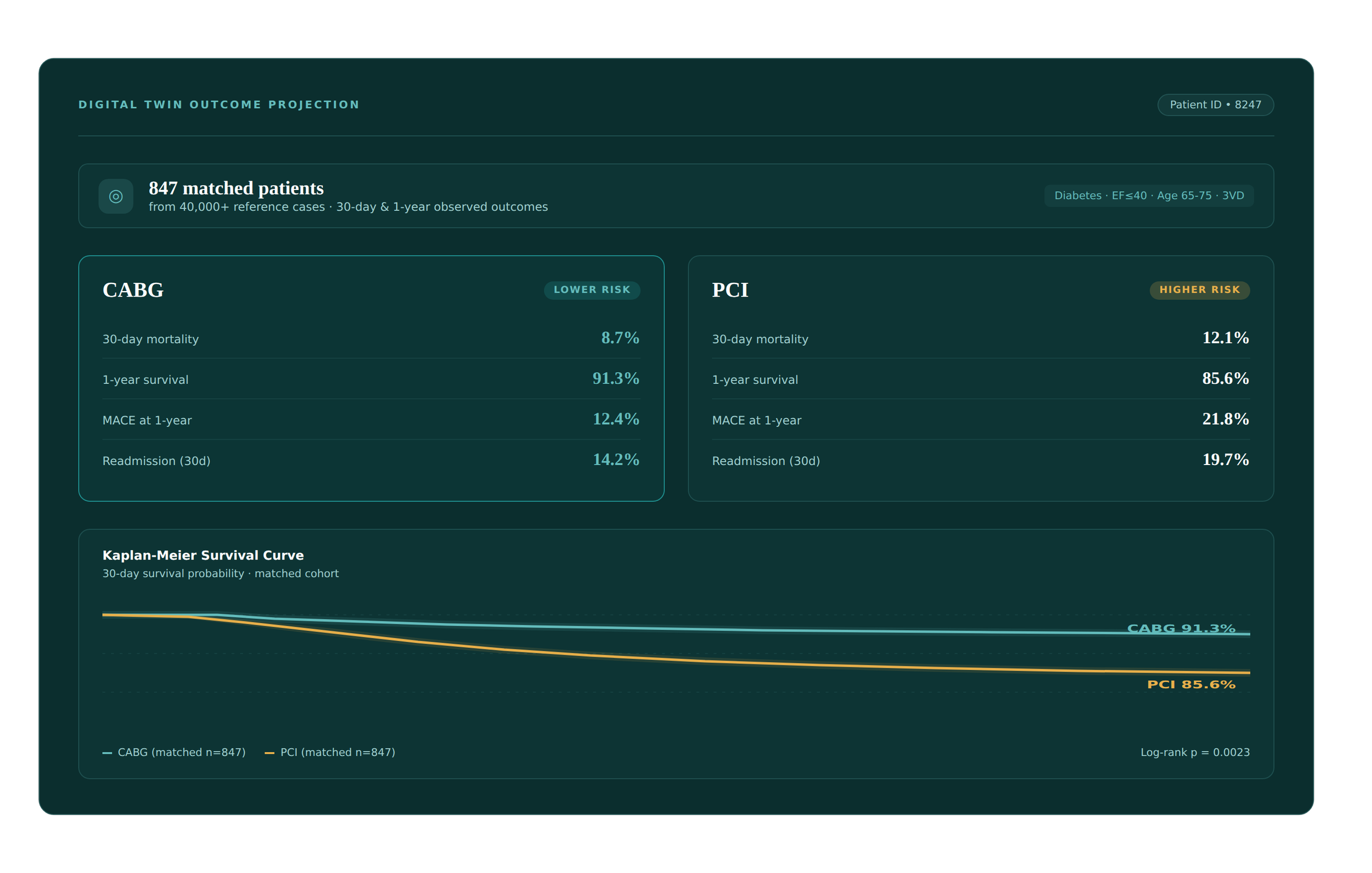
The Digital Twin Agent finds the most similar patients from historical cases and predicts outcomes under each treatment strategy presenting observed real-world survival for different procedure types using a matched cohort, with the similarity criteria fully visible.
-
The agent builds a high-dimensional patient embedding using demographics, comorbidity burden, left-ventricular function, coronary anatomy, and acuity. It then retrieves the closest-matching cases from the reference population using nearest-neighbor matching — returning the matched cohort size and the specific similarity criteria so the clinician can see exactly why each patient was selected.
-
The Digital Twin Agent returns observed 30-day and 1-year survival under each treatment strategy — PCI vs. CABG — for the matched cohort. Results are displayed as risk gauges and Kaplan-Meier survival curves. The 30-day mortality comparison is shown side by side (e.g. PCI 12.1% vs CABG 8.7%) so the heart team has a concrete, patient-specific risk differential before deciding.
-
The Digital Twin is validated across three large retrospective cohorts covering more than 40,000 coronary treatment decision cases with endpoints on 30-day mortality, 1-year mortality, and major cardiovascular events. Hold-out cohort testing was performed at multiple institutions. Every projection is reported with the matched cohort size — never as a single opaque number without a source.