Agent 01 · Guideline

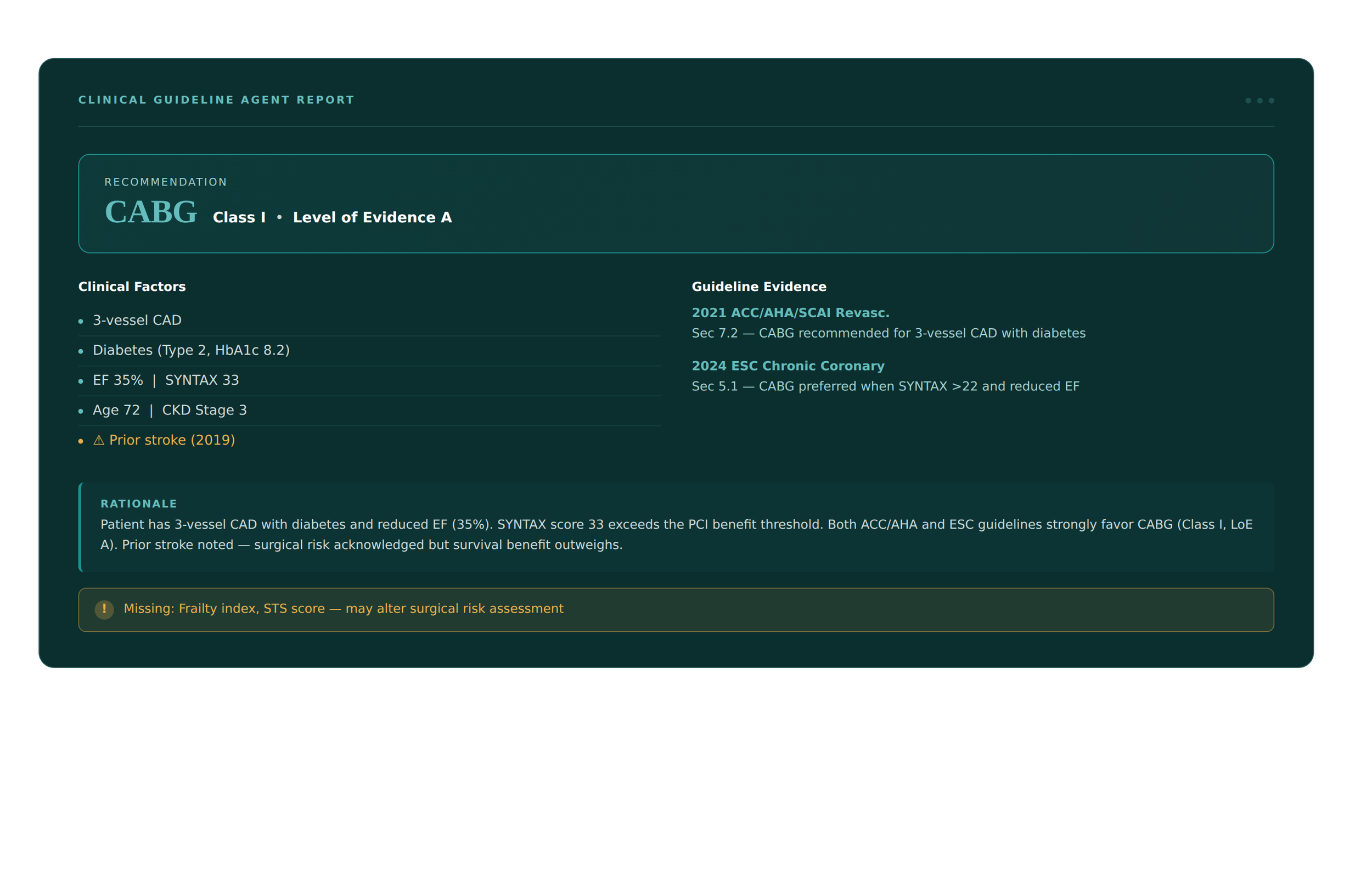
Clinical Guideline eligibility, with the citation attached.

The Guideline Agent maps the patient to the relevant sections of the current clinical guidelines and returns the eligibility class with the exact criteria that applied.

  • Pinned guideline versions. Versioned retrieval mapped to current evidence-based Clinical Guidelines and audited against an exhaustive gold-standard test set.
  • Class + Level of Evidence. Every recommendation returns Class I / IIa / IIb / III with Level of Evidence (LoE) and the specific rule text that matched.
  • Missing-data flags. If a frailty index, severity score, or other decision-altering variable is absent, APEX flags it rather than silently proceeding.
Common Questions
Each guideline source is version-pinned. When updated clinical guidelines are published, the new version is ingested, re-audited against a comprehensive library of clinical cases, and promoted only after regression tests pass. The report always cites the active guideline version.
Yes. Institutional protocols — for example a hospital's internal care pathway or appropriateness criteria — can be added as a secondary retrieval source to surface alongside standard Clinical Guideline citations.
The Guideline Agent shows conflicting citations side by side with their differing recommendations. The Heart-Team Report captures the disagreement in the rationale rather than silently picking one — providing a clinical signal the team should weigh.
Clinical Guideline Agent Report
Clinical Guideline AgentSample Case
Agent 02 · Digital Twin

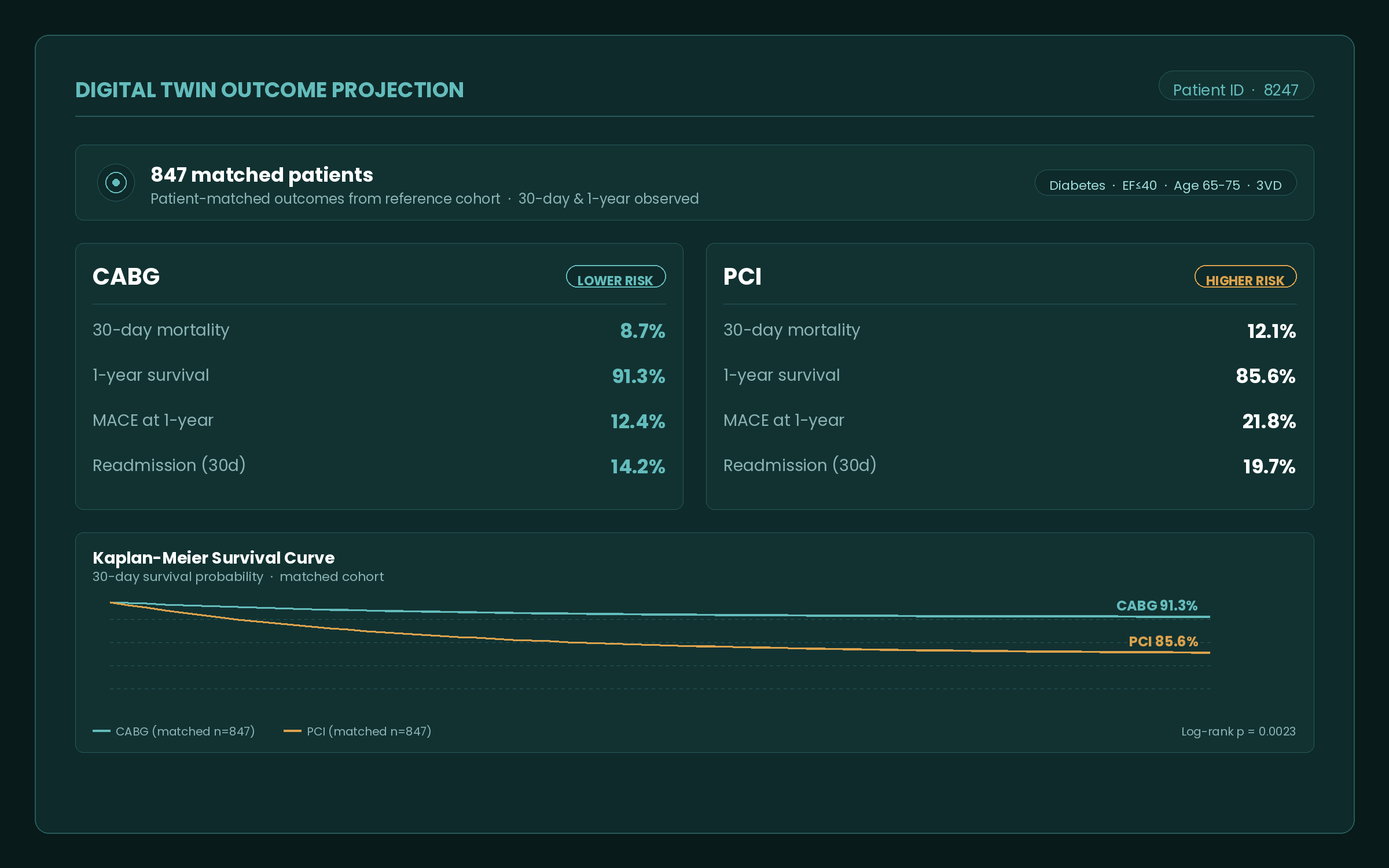
Patient-matched clinical insights — not an opaque score.

The Digital Twin Agent leverages advanced clinical profiling to surface contextual intelligence from extensive, high-fidelity data environments.

  • Intelligent Patient Matching. High-dimensional analysis of clinical characteristics and anatomy to provide the heart team with meaningful reference benchmarks.
  • Evidence-Driven Insights. Surfaces relevant care trajectories based on real-world clinical patterns to support data-backed decision making.
  • Transparent Intelligence. Unlike black-box algorithms, APEX provides an auditable trail of matched clinical profiles for full physician confidence.
Common Questions
Our intelligence library is built from curated, premium clinical data environments featuring longitudinal care records. We prioritize data integrity and provenance to ensure that every insight surfaced is grounded in high-fidelity clinical reality.
APEX evaluates the strength of clinical matches across thousands of variables. If the patient profile is exceptionally unique, the system prioritizes safety by flagging a need for additional clinical data rather than providing low-confidence insights.
No. While traditional scores reduce a patient to a single number, the Digital Twin surfaces the "why" behind the data. It empowers clinicians with curated, peer-group intelligence that enhances clinical judgment rather than attempting to replace it.
Digital Twin Outcome Projection
Digital Twin AgentClinical Intelligence Active
Agent 03 · Imaging

Stenosis detection the heart team can audit.

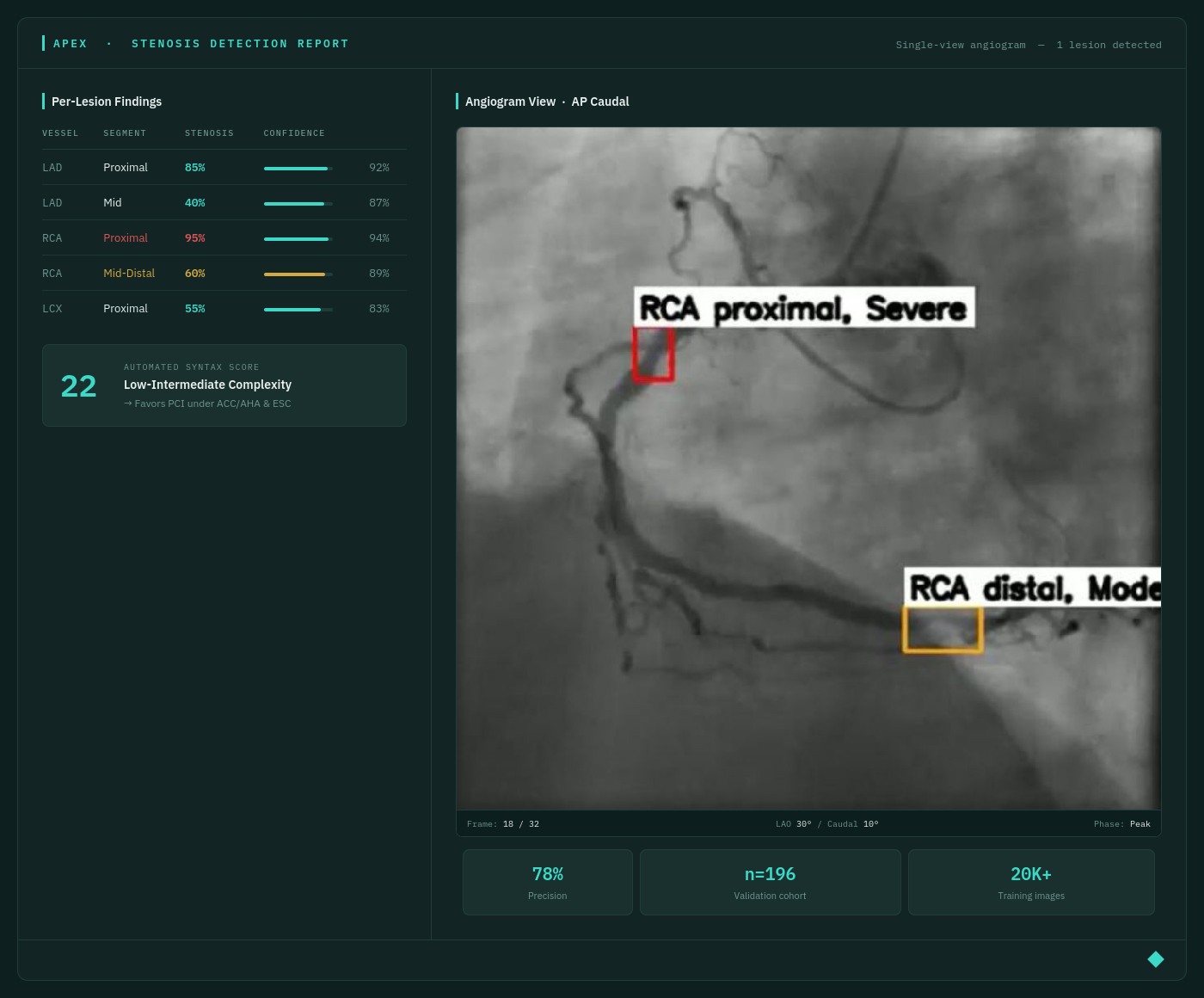
The Imaging Agent localizes and measures stenoses on angiogram frames. Every finding is linked to the source image and frame number — so the interventionalist can verify every assertion against the underlying study in one click.

  • Per-vessel percent stenosis. LAD, RCA, LCX with segment-level precision (proximal, mid, distal) and an explicit confidence score per lesion.
  • Automated Complexity Scoring. Computational tiering based on lesion patterns — aligning with the scoring systems used by Clinical Guidelines to stratify patient complexity.
  • Frame-level provenance. Every box on every lesion traces back to a specific frame, view angle, and contrast phase in the source DICOM.
Common Questions
DICOM angiograms (single or multi-view) and key stills. The agent auto-selects representative frames and view angles; the clinician can also pin specific frames for re-analysis.
The model was developed using a massive, diverse library of annotated angiographic data and rigorously evaluated. Performance meets high-precision standards for lesion localization and classification at the reporting threshold.
APEX Stenosis Detection Report
Imaging Agent Multi-Lesion Detection · Complexity Stratification
Agent 04 · Cohort Analytics

Inquire against the reference population in plain English.

The Cohort Agent transforms natural-language questions into technical insights against an expansive reference population. It instantly surfaces matched subgroups, observed outcomes, and publication-ready visualizations — providing the heart team with a data-driven compass for every case.

  • Conversational Intelligence. Ask complex clinical questions and receive precise population matches with full evidence-based transparency.
  • Real-World Evidence. Generate Kaplan-Meier curves, outcome tables, and subgroup analytics on the fly, tailored specifically to your patient's profile.
  • Precision Benchmarking. Contextualize treatment strategies against historical data and active clinical trends to optimize long-term care pathways.
Common Questions
The agent operates on a read-only architecture against validated schemas. Every insight is traceable back to the source data logic, ensuring that findings are both reproducible and audit-ready for clinical review.
Absolutely. In secure VPC or on-premise environments, the Cohort Agent can be integrated with your institution's structured data, enabling the team to query local patient history with the same conversational ease.
Cohort Analytics Agent
Cohort Analytics AgentREAL-WORLD EVIDENCE · GLOBAL BENCHMARKING
Agent 05 · Heart-Team Report

One synthesized consensus — with the reasoning trail intact.

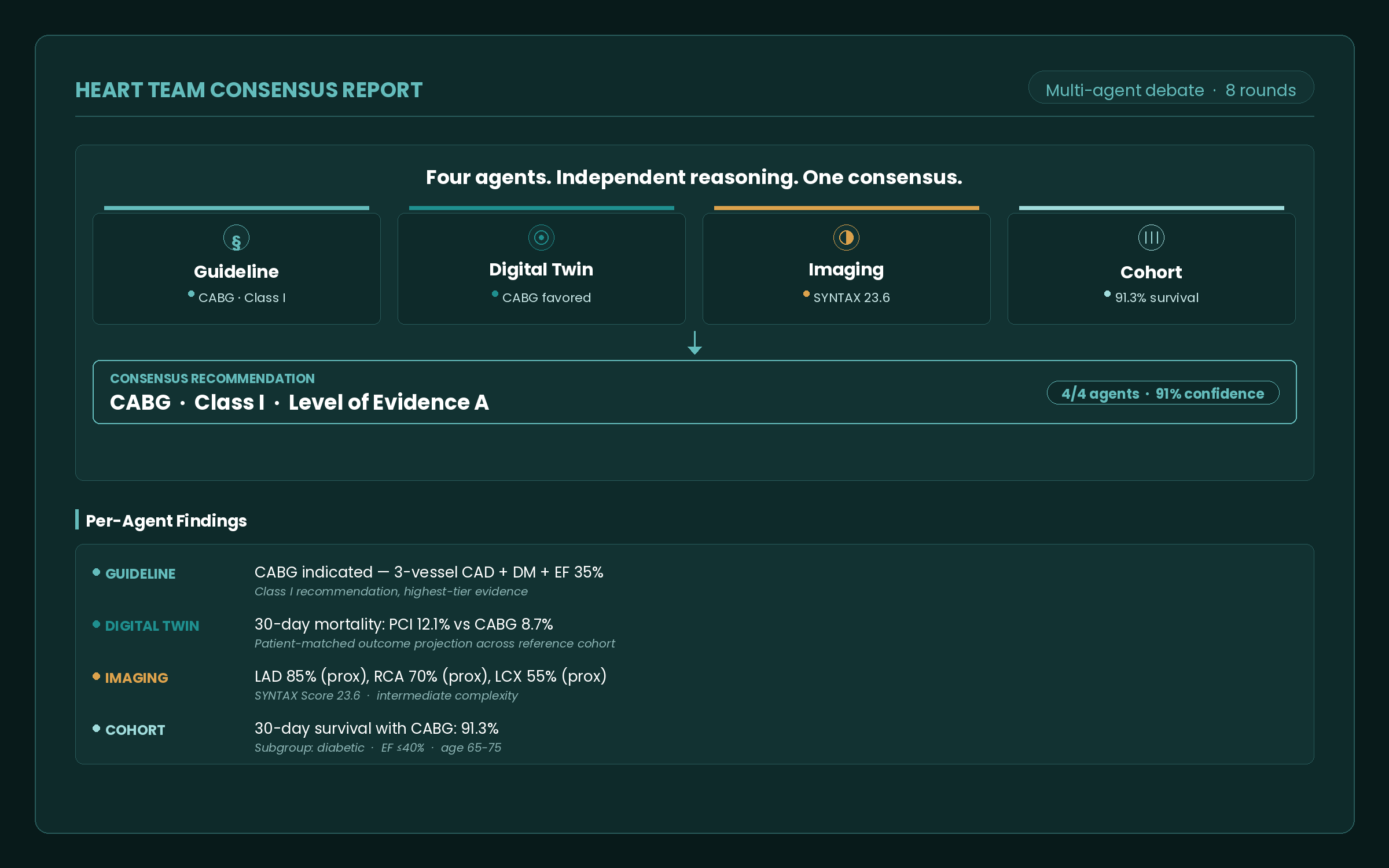
The Heart-Team Agent synthesizes guideline, digital twin, imaging, and cohort signals into a single structured consensus report. Every per-agent finding stays visible. Every recommendation is exportable.

  • Explicit agreement score. 4/4 agents · 91% confidence — the clinician sees at a glance whether the signals converge or dissent, with the dissenting agent highlighted.
  • Per-agent findings on expand. The audit trail — guideline citation, matched cohort size, imaging findings, observed survival — is one click away, never buried.
  • Multi-format export. PDF for the chart, structured JSON for downstream analytics, HL7 FHIR CarePlan for the EHR.
Common Questions
The Heart-Team Agent does not force a consensus. When agents disagree the report surfaces the disagreement explicitly. The final recommendation comes from the clinician's signoff, not the model.
No. APEX is clinical decision support — it supports the heart team's decision, it does not make it. Every report requires clinician signoff. The software is developed as SaMD clinical decision support and does not autonomously prescribe, diagnose, or treat.
The report is pre-generated overnight or on-demand before the Heart Team meets, so the meeting starts with the synthesized brief rather than a cold chart review. Teams typically cut meeting time per case while increasing cases reviewed per session.
Heart Team Consensus Report
Heart-Team Report Agent4/4 · 91% confidence
Bonus · Conversational Access

Full Heart Team consultation from your phone.

APEX is also reachable from a secure clinician messenger — ask for a case by ID and the full consensus report comes back in-thread. Built for on-call, the ER, and between cases.

  • On-call consults. Heart-team-level recommendation from home at 2 AM — without waiting for the morning meeting.
  • ER rapid triage. Risk stratification while the patient is still in the emergency department, not after disposition.
  • Teaching tool. Residents can see how guidelines, imaging, and cohort data converge on a single recommendation — with the reasoning shown.
Common Questions
Yes. The bot runs over a HIPAA-aligned secure channel with single sign-on and role-based access. Messages are encrypted in transit and at rest. Patient identifiers in chat are tokenized.
Currently the secure Dr. Data channel and HIPAA-configured deployments on enterprise messaging. Integration with hospital-sanctioned secure messaging platforms is scoped during pilot setup — deployment requirements vary by institution.
No — it is the same pipeline and the same report. The bot is a delivery channel optimized for mobile consumption. For complex cases the full web interface remains the primary surface.
APEX Physician Messenger Bot
APEX MessengerMobile · Secure
See it on a real case

Bring APEX to your heart team.

Book a 30-minute walk-through. We'll run a de-identified case end-to-end in the live product — guideline check, digital twin, imaging, cohort, and consensus report.

Request a clinical walk-through