

Data & Services

AI-augmented Decision Support
Using the latest large language models, patient data can be matched to clinical guidelines to suggest treatment options. Our proprietary ML model can create a Digital Twin of each patient to match them to historical patients and suggest which treatment option has the best chance of survival.
Digital Twin Technology: Smarter, Personalized Cardiac Care
Predictive Insights – Uses AI-driven "what-if" counterfactual analyses to enhance clinical decision-making.
Beyond Guidelines – Recognizes that not all treatment decisions align perfectly with clinical protocols.
Outcome Simulation – Matches patients with similar historical cases to predict outcomes for PCI and CABG interventions.
Risk Visualization – Helps cardiologists assess potential risks and benefits of different treatment options.
Revolutionizing Angiogram Analysis with AI
AI-Powered Interpretation – Leverages advanced AI to analyze angiograms with precision.
Automated Report Generation – Instantly creates detailed, accurate reports for cardiologists.
Faster Diagnoses – Minimizes diagnostic delays for quicker decision-making.
Reliable & Data-Driven – Ensures accuracy and consistency in angiogram interpretation.

Real-world Data
-
Request custom data sets from a large inventory of cardiovascular disease patients.
Standardized curation includes the most medically relevant data elements
Research-grade data
Supports data pooling if needed
-
Subscription gives real-time access to curated datasets that are periodically refreshed with new patient data.
Support clinical trials
Generate and explore hypotheses
Contextualize data generated in the clinical setting
Analytics Platform
A Platform for Providers
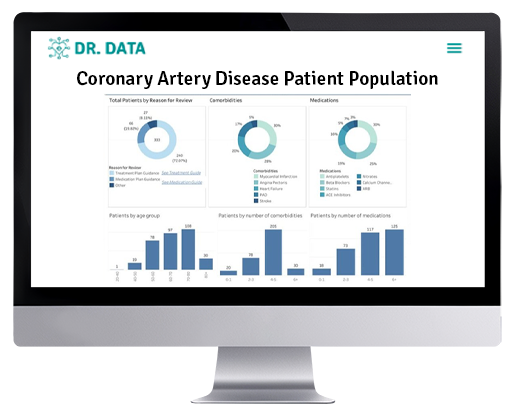
Users can easily access clinically relevant metrics and reporting needed to understand treatments and outcomes within their patient population.
Clinically curated EHR data
Point and click analytics detail the entire patient journey
Cohorting mechanism allows comparison of patient groups
Ability to report on patient outcomes

Analyze Your Data
-
We offer the highest quality data science and analytics services to help partners achieve their clinical, operational, and research goals.
Leadership and collaboration by top researchers and data scientists.
Option to deploy dedicated resources who will work on your projects only
-
Projects include:
Comparative Effectiveness Studies
Real-World Treatment Outcomes
Research publications
Performance improvement metrics
Supporting predictive modeling study or other complex analyses
Alternatively, Dr. Data offers tiered levels of engagement/consulting depending upon your needs.
Dr. Data support and involvement can range from input on 1 to 5+ data deliverables and 2 to 10+ meetings with Dr. Data technology and subject matter experts.